30 Dec 2024
A Surprising Revelation of Divinity in Art
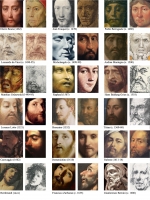
There are certain findings that should make all art lovers, including art scholars, think twice about whether we understand art. I have just published an in-depth article on how at least 49 Renaissance artists from all over Europe depicted themsel
13 Nov 2024
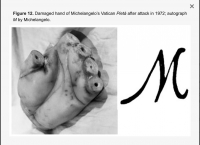
Why did Michelangelo put his initial inside the Virgin’s hand?
Newly revealed! All the best Western artists of sacred scenes have identified themselves with God and the Virgin for over six centuries. And it is not necessarily narcissistic. There are essential spiritual reasons for it. In fact, they had n
07 Nov 2024
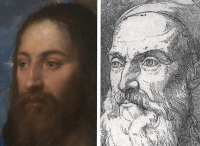
Artists paint themselves as God. Why has no-one noticed?
For nearly twenty years EPPH has revealed that major art is categorically different from lesser art. They should not both be called “art”. Major art always looks inwards at the individual artist, an interior vision of their mind which accounts
26 Jun 2024
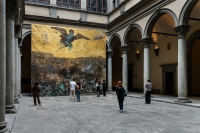
Names in Anselm Kiefer’s ‘Fall of the Angel’ at Palazzo Strozzi, Florence
Art “is something very difficult. It is difficult to make, and it is sometimes difficult…to understand.” And, Anselm Kiefer added, “it should always include having to scratch your head.”1 You can scratch your’s at his magnificent exhib
11 Jun 2024
Van Gogh’s Crosses on The Road to Tarascon
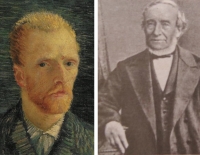
Vincent van Gogh’s uncle-by-marriage, J. P. Stricker, was an important catalyst in the formation of the painter’s world-view (fig. 1). A theologian and biblical scholar, Stricker did not believe in the literal, historical truth of Jesus’ lif

29 Dec 2020
The Hanging of Myra Hindley
The Moors Murders resonate in British minds of the post-war generation. Myra Hindley killed 5 children with her boyfriend and sexually assaulted four of them. Myra’s mug shot and the horrific crime is burnt into the memory of many. So by 1995 wh

21 May 2017
Art’s Timelessness
One of the exciting changes that can happen to you with an EPPH perspective is to discover that we all have the ability to see links between very different images. And the ways we do that are so far removed from conventional understanding that the

05 Apr 2016
The Poetry of Turner’s Eyesight
Artisans everywhere rely on the physical processes of sight. In the past that obvious fact was the basis of too much "interpretation". Impressionist paintings were said to have no meaning because they were exact reproductions of what the artists s

07 Mar 2016 | 1 Comments
Try Sleeping on Dürer’s Pillows
Surprise, surprise. In great art you never stop seeing new perceptions in long-familar images because art by its very nature exists on multiple levels. And seeing them without help from others is both edifying and deeply satisfying, certain to b
29 Feb 2016
Re-writing Writers on Art
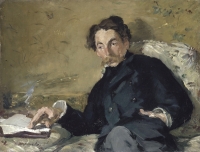
Years ago I thought that the Renaissance humanists who fought to have painting accepted as a liberal art knew a lot about the subject. It seemed a natural assumption but I was wrong. For us in search of art’s underlying meaning, it’s more im

21 Feb 2016
Harper Lee on Every Painter Paints Himself
Harper Lee’s passing reminded me of a deservedly famous line in To Kill A Mockingbird: "You never really understand a person… until you climb into his skin and walk around in it." To my mind she was not just portraying a wild imagination, as
20 Feb 2016
What are you?
If you follow EPPH and look at art as we do here, what are you? Art lover is too general and largely meaningless. Anyone can love art, even the seeker of a selfie with the Mona Lisa. You are more serious. You cannot be an art historian because w
14 Nov 2015
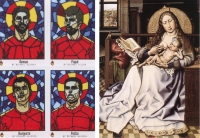
Balla’s Initial Idea
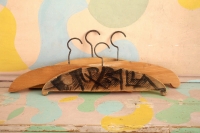
The house in Rome of Giacomo Balla (1871-1958), an Italian Futurist painter, is a kaleidoscope of color and creativity. I haven’t visited it but came across this photograph online of four of his clothes hangers. A commentator transcribes the h
04 Nov 2015 | 2 Comments
Giacometti Paints Himself (1966 Video)
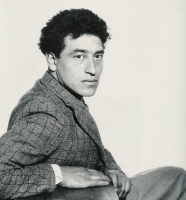
In a 1966 video (link below) Alberto Giacometti paints a portrait of Ernst Scheidegger, a Swiss photographer. We see how carefully and precisely he builds up the geometric structure of a face. What caught my attention, though, not knowing German

29 Oct 2015
On Art’s Unity
If anyone doubts that there is more unity to visual art than is currently recognized or imagined, think about what Maya Angelou, the American poet, had to say about art in general. She was not given to hyperbole or exaggeration and chose her w

10 Aug 2015
Eye-Opening: Michelangelo, Goya and Pixar’s Inside Out
Don’t get misled by Pixar's new Inside Out. It's not for children. It’s an animated film so obviously based on the paradigm of Western art that it demonstrates what EPPH has often argued: that ever since the 1940’s many, if not mos

01 Aug 2015
Joanna Woodall on Cooking Artists in Dark Rooms
Many are the ways to demonstrate that a given picture represents the artist in his or her mind: resemblance, pose, apparent errors, "nonsensical" shading, tools expressed in metaphor, etc. We have shown you at least thirty different methods, mos
25 Jul 2015
Gauguin’s Nose
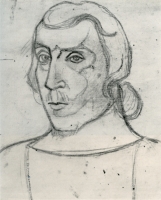
This is a little-known self-portrait of Paul Gauguin. The features seem to add up. That lantern jaw, signature moustache and the long, curling hair have been seen before. But, stop! What did he do to his nose? It's classical, Roman and as straight
10 Jul 2015
Hair, Brushes and Art
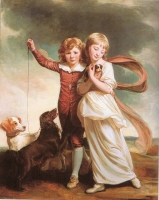
In pointing out yesterday that George Romney’s The Clavering Children (above) is more about Romney and his art than his young sitters, I left out a few points. Hair and its resonance.
Hair resembles a paintbrush and is brushed and,

05 Jul 2015
How Every Writer Writes Herself [from the Archives]
Short sayings like "Every Painter Paints Himself" often generate shallow interpretations. On first hearing that phrase I doubt anyone would recognize a whole philosophy. I didn’t and still haven’t plumbed its full depth and meaning.

04 Jul 2015
Miró‘s Advice for Young Painters
The just-published entry on Joan Miró's Self-portrait (1919) shows what he meant when, in a recording from 1951, he reminds young painters not to copy nature as taught in academies of art.
"He who wants to really achieve somet

18 May 2015
Still-lifes by Peale and Core [from the Archives]
Names are important in art. The American master Charles Willson Peale (1741-1827) had three sons who became painters: Rembrandt, Raphaelle [sic] and Titian. His fourth son was Rubens. Raphaelle is thought to be America’s first still-life painter

17 May 2015
Bread, art and metamorphosis
I just spent the past week learning how to bake bread properly, taught by an artisan baker. The effects were startling. Time passed unnoticed; the scraper became an extension of my body; and only by thinking of what it was like to be the dough d
15 Apr 2015 | 1 Comments
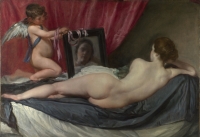
The World is a Mirror
Like many stories conveying wisdom, this anonymous one is slightly silly. However, it suggests why so many masterpieces of painting, like Velazquez’s Las Meninas for instance, only make sense when its surface is seen as reflective. No doubt th
03 Apr 2015
Good Goal: Study Design
Once in a while I try to remind myself to study good graphic design because, while illustration is not art, it uses the same techniques more openly. Illustration's purpose is not to hide meaning that most people will misconstrue as in art but

26 Mar 2015
Ssh! The Secret of Picasso’s Ear
Ears make sense as one of the five: touch, taste, sight, sound and smell. But who thinks about Picasso's ears? We mostly remember his eyes: deep, dark and powerful. Yet he himself - as I don't think has been noted before - seems to have been very

25 Mar 2015
Wisdom, Art and a Cat
I'm always on the lookout for written expressions of the basic ideas about visual art conveyed on EPPH. Here's one that backs up the concept that art and the practice of it leads to wisdom. A beautiful old Irish poem, now known as Pangur Bán af
20 Mar 2015
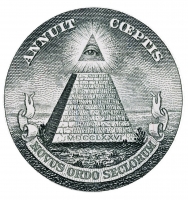
Whose God is on the dollar bill?
Art is too often seen as a literal representation of the artist's own small, physical world. The idea that it uses metaphoric language to express much larger, eternal truths shared by all mankind is seldom realized. The same happens with the dol

06 Mar 2015
C.S. Lewis on a Poetic Method
The late Sidney Geist, a sculptor and controversial interpreter of Cézanne's art, invited me about 12 years ago to come and see him at his studio in Manhattan. I had spent the past year studying everything about Edouard Manet and was excited to
The EPPH Blog features issues and commentary.