Manet’s Boy with Cherries (1860)
Manet’s Boy with Cherries (1860), an early work, is a good example of how one great master identifies with another even when young and little known. Manet painted it a few years after his trip to Italy where he had seen and copied works by the fifteenth-century master, Perugino, who had significantly been Raphael’s teacher.

Manet, Boy with Cherries (1860) Oil on canvas. Fundação Calouste Gulbenkian, Lisbon.
Click image to enlarge.
The model here is said to be Manet’s studio assistant who hanged himself in the studio a few months later. Of course, we have no idea what the boy looked like and it is doubtful that this is a good likeness. Poetic painters are rarely interested in an accurate resemblance because their primary concern is to make the subject an aspect of their own minds.
Click next thumbnail to continue.
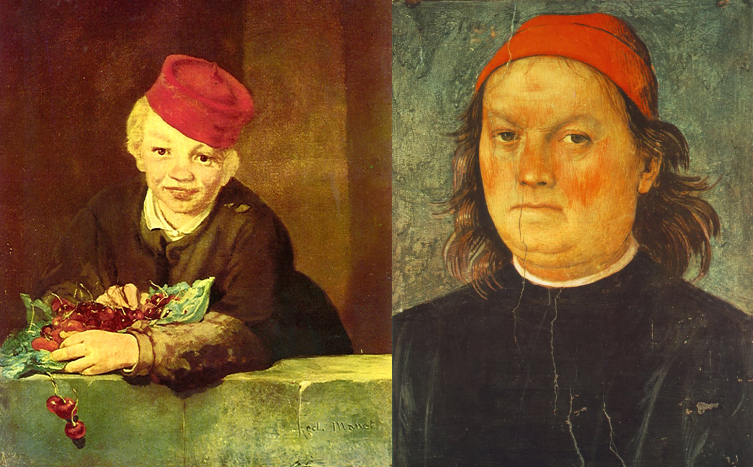
L: Manet, Boy with Cherries
R: Perugino, Self-portrait
Click image to enlarge.
In this case, Manet used the pattern of Perugino's eyes and eyebrows as he appears in a self-portrait. (Click on the image to see a clearer comparison.) The remaining features probably belong to the boy. The red hat confirms the link.{ref1}
See conclusion below.
While several great artists like Picasso have sometimes wondered whether they are a reincarnation of each other, many in maintaining this unspoken tradition across the centuries have identified with each other. They feel at one with those who have thought likewise and in whose tradition they work. It is, besides, another way of painting their own reflection because, no matter what, in great art every painter paints himself.
More Works by Manet
Notes:
1. Gozzoli also painted himself wearing a red cap, in a set of murals from 1461 that Manet probably saw during his month-long trip to Italy in 1853.
Publication Date: 24 Oct 2010
© Simon Abrahams. All articles on this site are the copyright of Simon Abrahams. If you wish to use copyrighted material from this site in print or other media for purposes that go beyond 'fair use', you must obtain permission from the copyright owner. Other websites may link to this page without permission (in fact, please do) but may not reproduce the material on their own site.